Adopt a Babushka: Why Diaspora Millennials Are Basically Collecting Belarusian Grandmothers
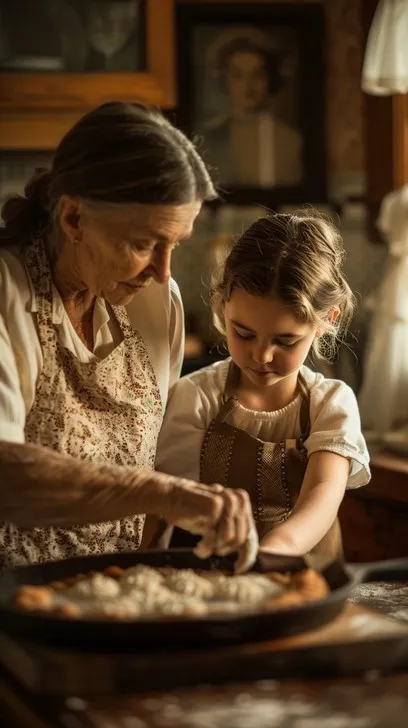
Photo: elderly Belarusian woman teaching young person in kitchen traditional cooking, via images.stockcake.com
Let's be honest — nobody grows up thinking, I really hope I get adopted by a 74-year-old Belarusian woman who will judge my soup and change my life. And yet, here we are.
In diaspora communities scattered from Chicago to Brooklyn to suburban New Jersey, something quietly remarkable has been unfolding. Young Americans — some with Belarusian roots, many without a single drop — are actively seeking out relationships with older Belarusian women. Not in a quirky internet trend way. In a genuine, show-up-on-a-Tuesday-with-groceries, learn-how-to-pickle-things, get-lectured-about-your-posture kind of way.
The babushka — that word carrying decades of Soviet-era practicality, homegrown herbs, and zero tolerance for nonsense — has somehow become one of the most sought-after relationship figures among a generation that grew up being told they could Google anything.
What Even Is the Babushka Effect?
It's not a formal program. There's no app. Nobody's swiping right on a grandmother profile. The connections tend to happen organically — through community centers, Orthodox parishes, Belarusian cultural organizations, or simply because someone's coworker mentioned their baba makes the best kholodnik in the state and one introduction led to another.
What researchers who study immigrant communities have started noticing is a pattern: younger people, particularly those in their late 20s and 30s, are actively filling what sociologists sometimes call an "elder gap." Many millennials grew up in smaller nuclear families, often geographically separated from grandparents. Some lost grandparents early. Others simply never had the intergenerational household experience that was completely normal in Soviet-era Belarus, where three generations under one roof wasn't a lifestyle choice — it was just Tuesday.
Belarusian grandmothers, it turns out, fill that gap with a particular intensity.
The No-Nonsense Wisdom Industrial Complex
Here's the thing about babushkas that younger people keep coming back to: they do not hedge.
In a cultural moment absolutely saturated with qualified statements, wellness disclaimers, and carefully worded LinkedIn posts, the directness of an older Belarusian woman lands like a cold splash of water — jarring, then weirdly refreshing. Ask a babushka if your apartment is clean enough and she will tell you. Ask if your boyfriend seems like a good man and she will tell you that too, possibly with a relevant proverb.
Mara, a 31-year-old graphic designer in Philadelphia whose family is originally from Minsk, describes her relationship with her neighbor's grandmother as "the most honest relationship I have in my life, and I mean that as a compliment." She started dropping by for tea two years ago. Now she helps with grocery runs and gets a standing invitation to Sunday dinner. "She told me my career was going nowhere the third time we met. She was right. I changed jobs six months later."
There's a cultural logic here that's worth unpacking. Belarusian grandmothers came of age in an era where survival required practical knowledge — real, actionable, material knowledge. How to preserve food through a winter. How to stretch a household budget into something that actually feeds people. How to read weather patterns, manage a garden, treat a cold without running to a pharmacy. This wasn't wisdom as lifestyle content. It was wisdom as infrastructure.
Keepers of the Weird Stuff Nobody Else Remembers
Beyond the life advice, there's something else younger people are hungry for: the specific, textured, slightly strange cultural knowledge that doesn't make it into books or YouTube tutorials.
The exact way you're supposed to fold pelmeni so they don't fall apart in the pot. The particular song you hum while doing something tedious because your grandmother hummed it and her grandmother hummed it before that. The names of wildflowers. The right time to plant things. The prayers that aren't exactly religious but aren't exactly not.
This kind of knowledge is genuinely endangered. It doesn't live in archives. It lives in people, and it travels through relationship — through sitting in someone's kitchen long enough that things just start coming up naturally.
For Belarusian-Americans who feel a pull toward their heritage but didn't grow up speaking the language or practicing the customs, a babushka relationship can function as a kind of living portal. Less like a history lesson, more like being handed a key to a house you always knew existed but never had access to.
The Millennials Aren't the Only Ones Getting Something Out of This
It would be easy to frame this entirely as younger people extracting wisdom from older ones, but that's only half the picture.
Isolation among elderly immigrant women in the US is a real and serious issue. Language barriers, reduced mobility, the death of spouses and peers, adult children absorbed in their own busy lives — the circumstances that leave older Belarusian women alone in American cities are not hard to imagine. The arrival of a curious, attentive younger person who genuinely wants to learn how to make draniki properly is not a small thing.
Community workers at several Belarusian cultural organizations across the US have noted that these informal intergenerational connections seem to have measurable effects on older women's mood, engagement, and sense of purpose. One coordinator in Chicago described it simply: "They feel needed again. And they are needed."
There's something almost corrective about this dynamic — a small repair of something the modern world broke a little when it scattered families across continents and told everyone to be self-sufficient.
So How Do You Actually Find Your Babushka?
If you're reading this and thinking, honestly, I could use a grandmother figure in my life, you are not alone and you are not weird.
Belarusian cultural centers and diaspora organizations exist in most major US cities and several mid-sized ones. Orthodox and Catholic parishes with Belarusian congregations are another genuine entry point — community meals after services are a time-honored tradition and a natural place to meet people. Online groups for Belarusian diaspora communities have also become more active in recent years, and plenty of connections start there before moving offline.
The main thing, according to everyone who's been through this, is to show up consistently and without an agenda. Don't arrive looking for a cultural transaction. Arrive the way you'd arrive at a neighbor's door — with a little time, a little curiosity, and maybe something to contribute.
The rest, apparently, tends to take care of itself.
And yes, you will probably be told your soup needs more dill. Take the note. She's right.