Kick the Can, Belarusian Style: How Old-School Street Games Are Pulling Gen Z Away From Their Phones
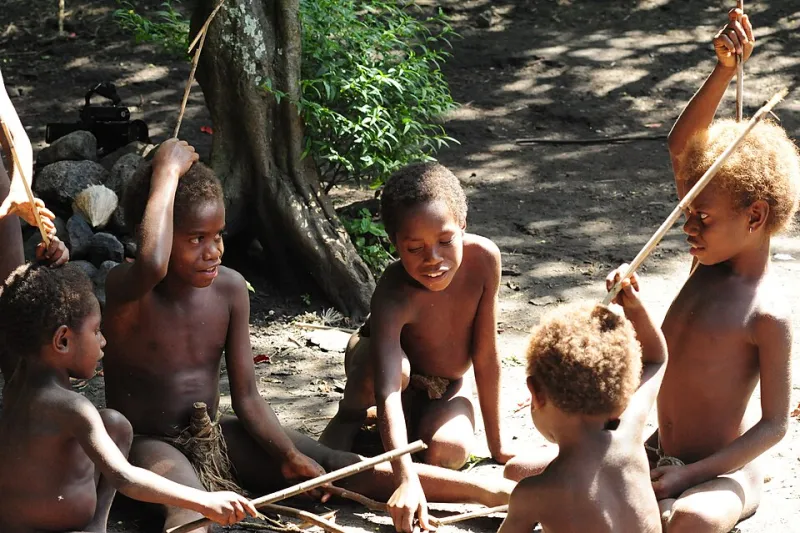
Photo: Choguet, CC BY-SA 3.0, via Wikimedia Commons
Somewhere between a Soviet-era apartment block and a cracked concrete courtyard, a group of teenagers is playing a game that their grandparents would recognize instantly. No phones out. No streaming. Just a worn-out stick, some chalk on the pavement, and a set of rules passed down through generations of Belarusian kids who grew up without Wi-Fi as an option.
This isn't a heritage festival. It's not a school assignment. It's just Tuesday afternoon, and apparently, this is what fun looks like now.
The Games That Never Really Went Anywhere
To understand the revival, it helps to know what we're talking about. Belarusian street game culture is rich and specific — a mix of games that are uniquely regional and others that share DNA with playground staples across the former Soviet Union and Eastern Europe more broadly.
Take Lapta, often described as a distant Slavic cousin of baseball. Players hit a ball with a wooden bat and run between bases while the opposing team tries to tag them out. It's fast, it's physical, and it requires exactly zero downloads. Then there's Klasiki — the Belarusian take on hopscotch, played on grids chalked onto pavement in patterns that vary by region and by whoever drew them that day. Simple enough for a six-year-old, weirdly competitive once you've been playing it for an hour.
Zhmurki, a blindfolded tag game that translates roughly to something like "blind man's bluff," is another one showing up again. And Vyzhygalki, a dodgeball variant with its own particular rules, has been spotted in parks and schoolyards in ways that would have seemed unlikely five years ago.
None of these games disappeared entirely. They survived in pockets — in smaller towns, in family gatherings, in the memories of people who grew up playing them. But in urban spaces, especially in Minsk, they'd largely been elbowed out by the same digital entertainment that took over everywhere else. What's changed is that some of those same urban spaces are now seeing them come back.
Why Gen Z Is Interested (This Is the Interesting Part)
Here's where it gets genuinely surprising. The revival isn't being driven by parents trying to get their kids off screens, or by educators pushing cultural enrichment. In a lot of cases, it's young people themselves — teenagers and people in their early twenties — who are actively seeking these games out.
Some of it is TikTok, which is a little ironic given the whole offline angle. Short videos of people playing Lapta or elaborate Klasiki variations have circulated widely enough to spark curiosity. The visual appeal is real — there's something visually satisfying about watching a well-executed street game that translates well to a vertical video format. The algorithm, apparently, does not discriminate against analog fun.
But the TikTok pipeline is just the on-ramp. What's keeping people engaged is something that goes a little deeper. Interviews with young Belarusians — compiled by cultural researchers and journalists who've been tracking this trend — point to a genuine fatigue with the particular kind of socializing that digital platforms offer. You can have hundreds of online connections and still feel like you spent your Saturday alone. Playing Zhmurki in a courtyard with eight people for two hours delivers something that a group chat simply cannot.
There's also a nostalgia component, but it's a specific kind of nostalgia. These Gen Z players didn't grow up playing these games — they're too young for that. What they're nostalgic for is a version of childhood they never had but have absorbed through family stories, old photographs, and a cultural memory that's embedded in Belarusian life in ways that are hard to fully articulate. Reclaiming the games is, for some, a way of connecting to a Belarusian identity that feels more grounded than what social media tends to offer.
The Courtyard as Cultural Space
It's worth pausing on the setting, because it matters. The courtyard — dvor in Russian, dvor in Belarusian — is a specific architectural and social feature of Soviet-era residential design. Apartment buildings were arranged around shared outdoor spaces that functioned, in theory, as community hubs. Kids played there. Adults gathered there. The dvor was, for decades, the primary social infrastructure of everyday Belarusian life.
That function eroded as entertainment moved indoors and then onto screens. The courtyards didn't disappear physically — they're still there, between the same apartment blocks — but they emptied out in a social sense. The street game revival is, in part, a reclamation of that space. Young people are rediscovering that these outdoor areas can still function as gathering points, that the architecture of their neighborhoods was designed with communal life in mind.
For American readers, a rough equivalent might be imagining a generation of young adults deciding to actually use their neighborhood parks for the kind of unstructured, multi-hour hangouts that those spaces were theoretically designed for. It's not a perfect analogy, but the underlying impulse — reclaiming a physical community space that had been abandoned to other purposes — translates pretty well.
Cultural Identity Hiding in Plain Sight
There's a political and cultural dimension to this trend that's worth naming, even if it doesn't fully define it. Belarus has a complicated relationship with its own distinct cultural identity. The Belarusian language, traditional folk practices, and specifically Belarusian cultural expressions exist in ongoing tension with Russian cultural dominance and with Soviet-era homogenization that flattened regional distinctiveness across the entire bloc.
Reviving specifically Belarusian street games — as opposed to generic Soviet-era games that were common across multiple republics — is, for some participants, a quiet act of cultural assertion. It's a way of saying: this specific thing came from here, belongs to here, and is worth keeping alive. That's not the primary motivation for everyone picking up a bat to play Lapta on a Wednesday afternoon. But it's present in the conversation, and it adds a layer of meaning to what might otherwise look like simple nostalgia.
What This Looks Like From the Outside
For US observers, the Belarusian street game revival is a useful data point in a larger conversation about digital fatigue and the search for embodied, in-person community that's happening across a lot of different cultures simultaneously. American Gen Z has its own version of this — the resurgence of board games, the appeal of bowling alleys and mini golf, the genuine enthusiasm for activities that require physical presence.
What makes the Belarusian version distinctive is the specific cultural content it's drawing on. These aren't generic offline activities. They're games with names, histories, and regional variations — games that carry a specific place's memory inside them. That particularity is part of what makes them worth paying attention to.
Somewhere in Minsk right now, a group of twenty-somethings is probably arguing about the correct rules for Vyzhygalki. Their phones are in their pockets. Nobody is filming it. And it's probably a pretty good time.