Stitched Into the Fabric: How Belarusian Embroidery Became a Quiet Act of Defiance
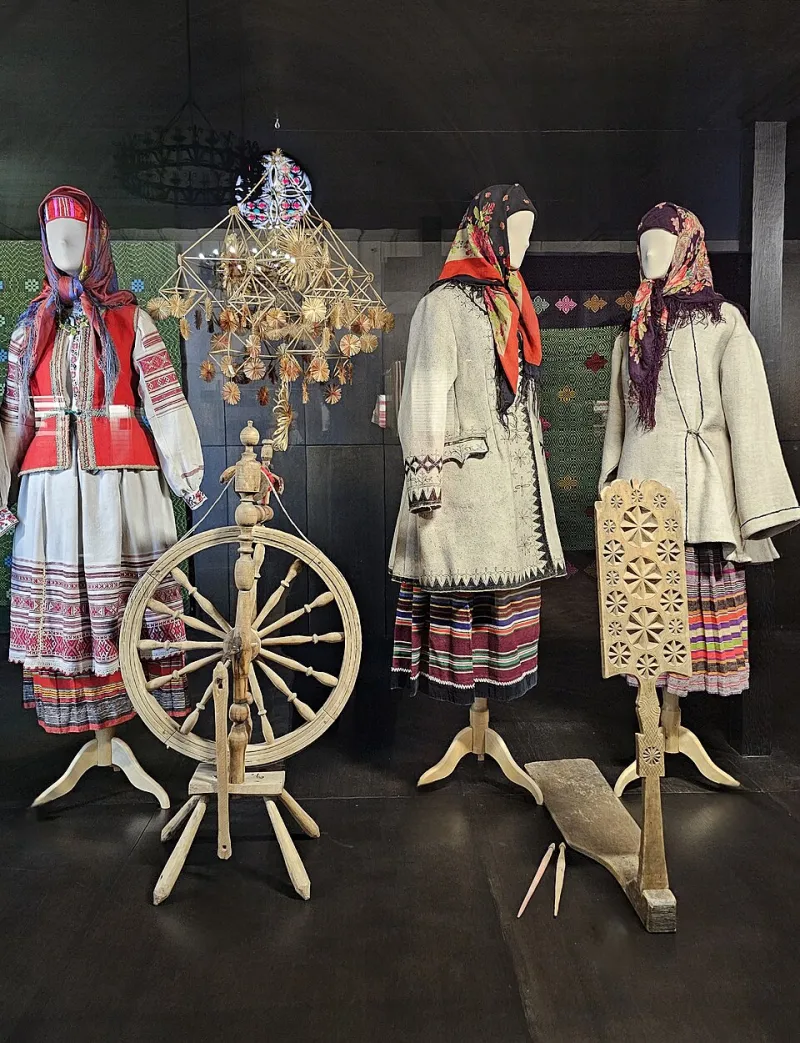
Photo: Tatiana Markina, CC BY-SA 4.0, via Wikimedia Commons
Picture a white linen shirt, folded neatly on a shelf in some Belarusian grandmother's wardrobe. The collar and cuffs are bordered in deep red geometric shapes — diamonds nested inside diamonds, eight-pointed stars marching in rows, tiny rhombuses that seem to vibrate if you stare long enough. To a passing eye, it looks like folk decoration. Something quaint. Something old.
But pull up a chair, because that shirt is telling you something.
Belarusian embroidery — called vyshyvanka in its broader Slavic context, though Belarus has its own distinct regional vocabulary — is one of those cultural artifacts that looks decorative on the surface and turns out to be a whole language once you start paying attention. And right now, both inside Belarus and across diaspora communities in places like Chicago, New York, and the Pacific Northwest, people are paying very close attention.
A Pattern Language Older Than the Nation Itself
The embroidery traditions of Belarus predate the modern nation by centuries, rooted in pre-Christian Slavic folk practice. Early patterns weren't random aesthetic choices — they were protective symbols, fertility markers, and spiritual shorthand. A diamond with a dot in the center traditionally represented a sown field, a prayer for agricultural abundance. Interlocking crosses formed barriers against misfortune. The eight-pointed star, which shows up again and again across Belarusian textile regions, connected the wearer to cosmic cycles of sun and season.
Different regions developed distinct visual dialects. The Polesie area in the south favored dense, almost hypnotic geometric grids in red and black. The Vitebsk region in the north leaned toward more open, airy compositions with floral elements. Grodno embroidery incorporated color palettes that reflected trade influences from neighboring Poland and Lithuania. If you knew how to read it, a single piece of embroidery could tell you roughly where someone was from, what season it was made for, and sometimes even what life stage the wearer was in — unmarried women, brides, and mothers each had their own symbolic vocabularies worked into their garments.
This wasn't folk art as decoration. It was folk art as communication.
The Soviet Interruption — and What Survived
Soviet cultural policy did a number on Belarusian textile traditions, as it did on so much of the region's cultural heritage. Embroidery was tolerated — even promoted — as long as it fit the approved image of cheerful, generic "Soviet folk craft." The deeper symbolic layers, the regional specificity, the pre-Christian spiritual associations: those were quietly flattened. Craft cooperatives standardized patterns. The regional dialects of stitch and symbol started blurring together.
And yet, things survived. In rural households, grandmothers kept stitching the way they'd been taught. Pattern books were copied by hand and passed between neighbors. Some knowledge went underground simply by staying domestic — too quiet and too ordinary to attract official attention. The embroidery didn't disappear; it just waited.
The post-Soviet period brought a slow, uneven revival. Academic researchers began documenting regional pattern archives. Craft schools reopened. Young people started asking their grandmothers questions before it was too late.
From Folk Craft to Political Symbol
Here's where things get genuinely fascinating — and where Belarusian embroidery starts to feel urgently relevant rather than charmingly historical.
After the disputed 2020 presidential election in Belarus and the massive wave of protests that followed, traditional Belarusian symbols became flashpoints. The white-red-white flag, which predates Soviet rule, became the banner of the protest movement. And alongside it, vyshyvanka patterns started appearing everywhere — on protest signs, painted onto banners, printed on t-shirts worn to demonstrations.
Wearing embroidered folk patterns in Belarus today carries weight. It signals an attachment to a Belarusian cultural identity that is distinct, pre-Soviet, and explicitly not Russian — a statement that has become increasingly pointed given the political climate. For activists and ordinary citizens alike, putting on a shirt with traditional embroidery isn't just a fashion choice. It's a position.
Artists have been particularly bold about this reclamation. Belarusian textile artists and illustrators have been reworking traditional patterns into contemporary contexts — combining centuries-old geometric motifs with modern graphic design, screen printing traditional symbols onto protest-adjacent merchandise, and creating embroidery-based visual art that explicitly connects folk heritage to present-day resistance. Some of this work gets shared across social media platforms, reaching diaspora audiences who might be three generations removed from Belarus but suddenly find themselves deeply moved by a diamond-and-star motif on their phone screen.
What the Diaspora Is Doing With It
In the United States, Belarusian diaspora communities have been experiencing their own version of this embroidery revival. It shows up in interesting ways. Craft circles in cities with established Belarusian communities have seen renewed interest in traditional needlework, with younger members — people in their twenties and thirties — showing up to learn techniques their parents never taught them. Online communities connect Belarusian Americans with pattern archives and tutorial videos. Etsy shops run by diaspora artisans sell embroidered goods that are explicitly framed around Belarusian cultural identity, not generic Eastern European folk craft.
There's something emotionally specific happening here that's worth naming. For diaspora communities watching events in Belarus from thousands of miles away, engaging with embroidery traditions is one of the few forms of connection and solidarity that feels both personal and concrete. You can't vote in Belarusian elections from Ohio. You can't march in Minsk from Seattle. But you can learn the pattern your great-grandmother used, stitch it onto something, and wear it somewhere someone might ask what it means.
That's not nothing. That's actually quite a lot.
Why American Audiences Should Lean In
If you're reading this from the US without any Belarusian roots, you might be wondering why any of this should land for you. Fair question.
Here's one answer: Americans have their own complicated relationships with folk traditions as political symbols — think of how quilting has been documented as a form of coded communication among enslaved communities, or how Indigenous beadwork patterns carry cultural survival narratives that resist erasure. The idea that decorative textile traditions can carry resistance, identity, and coded meaning isn't foreign to American cultural history. Belarus is just doing its version of something humans have done across cultures for as long as we've been making things with our hands.
Another answer is simpler: it's beautiful, and it's a story most Americans have never heard. Belarusian embroidery doesn't get the cultural tourism treatment that, say, Japanese textile arts or Scandinavian folk patterns get in the Western media. It tends to get lumped into a vague "Eastern European folk stuff" category and overlooked. Which means that when you actually look at it — really look at it — it hits differently. The precision of those geometric forms, the regional variety, the centuries of meaning compressed into repeating shapes on linen: it's genuinely stunning.
The Stitch as Statement
Near the end of a recent conversation on a Belarusian diaspora forum, someone posted a photo of a piece of embroidery they'd found while going through a late relative's belongings. They didn't know what region the pattern was from or what the symbols meant. They just knew it mattered, and they wanted to understand why.
The thread that followed — people sharing pattern identification resources, regional archive links, personal family histories — ran to hundreds of replies.
That's the thing about embroidery as a cultural form. It survives because it's physical, because it's personal, because it lives in drawers and trunks and attic boxes rather than institutions. And when the moment comes to reach for something that says this is who we are, it turns out people know exactly where to look.