Five Stories of Thin Walls and Shared Staircases: What Soviet Apartment Blocks Actually Mean to Belarusians
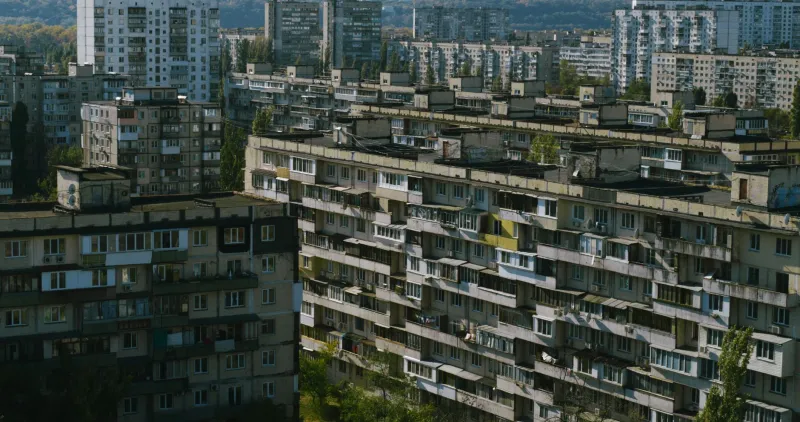
If you've ever scrolled through travel photos of Minsk and stopped dead on a shot of those enormous concrete residential towers lining the boulevards, you're not alone. Americans tend to react to Soviet-era Belarusian apartment blocks the way they react to abstract art — equal parts confused, vaguely unsettled, and weirdly drawn in. What are those things? Who decided this was a good idea? And why does every Belarusian you mention them to get this particular look on their face — half grimace, half something that looks suspiciously like fondness?
Let's unpack that.
The Logic Behind the Slabs
To understand the khrushchyovka — the squat, five-story blocks named after Soviet Premier Nikita Khrushchev — you have to understand the postwar housing crisis that spawned them. By the mid-1950s, the Soviet Union was dealing with catastrophic urban overcrowding. Entire families were sharing single rooms in communal apartments. The solution wasn't elegant, but it was fast: standardized prefabricated concrete panels, factory-produced and assembled on-site like enormous Lego sets.
The math was brutal and deliberate. Ceilings just high enough. Rooms just wide enough. Kitchens sized for one person to cook without spinning around. No elevators in the five-story versions because Soviet urban planners had decided, apparently with great confidence, that five flights of stairs was a perfectly reasonable ask. These weren't dream homes. They were a nationwide infrastructure project disguised as housing.
The later panelka designs — taller, built through the 1960s, '70s, and into the '80s — scaled everything up but kept the same utilitarian DNA. Twelve stories. Sixteen stories. Endless repetition of window-balcony-window-balcony running down the facade like a spreadsheet someone forgot to close.
What Life Inside Actually Looked Like
Here's what the blueprints didn't account for: people are relentlessly, stubbornly human.
The thin walls that Soviet planners considered an acceptable engineering compromise became an accidental community technology. You knew your neighbors' arguments, their cooking schedules, their television preferences, the sound of their particular footstep on the landing. Privacy was theoretical. Community was mandatory.
The shared stairwell — the podezd — functioned as a kind of informal neighborhood commons. Kids congregated there in winter. Gossip traveled through it like a wire. Older residents kept mental logs of who came and went. In a country where public political life was heavily managed, the podezd was one of the few genuinely unscripted social spaces available.
Balconies, officially meant for storage or laundry, became extensions of personality. Somebody grew tomatoes. Somebody else built out an enclosed sunroom with mismatched glass panels. A third neighbor installed wind chimes that drove the entire floor mildly insane for fifteen years. The exterior of these buildings, monotonous in the architect's rendering, became genuinely chaotic up close — a patchwork of individual decisions layered over identical bones.
Why Americans Can't Look Away
There's a term that architecture nerds have been throwing around for a while now: ruin porn. The slightly guilty pleasure of staring at decayed or brutalist structures, finding beauty in their blankness. Soviet residential blocks have become a fixture of this aesthetic, filling Instagram feeds and architecture blogs with their imposing geometry.
But the American fascination goes a little deeper than aesthetics. These buildings represent a completely alien approach to the relationship between the state and domestic life — one where the government literally designed the dimensions of your kitchen and decided how many square meters your family deserved. For people raised in a culture that treats homeownership as a cornerstone of personal freedom and identity, there's something genuinely disorienting about that. The apartment blocks aren't just visually striking. They're philosophically strange.
And that strangeness is interesting. It raises questions Americans don't usually have to ask: What does home mean when it was designed by a committee? What does neighborhood mean when every building on the block is identical? What does privacy mean when your walls are four inches of prefab concrete?
The Diaspora Feeling Nobody Talks About Enough
Ask a Belarusian American about the apartment block they grew up in and brace yourself for a complicated answer.
The complaints come first, usually. The elevator that broke every February. The neighbor who smoked in the stairwell for thirty years. The kitchen so small that holiday cooking required a kind of spatial negotiation that bordered on performance art. The summer heat that collected in the upper floors like something with malicious intent.
And then — and this is the part that surprises people — the other stuff.
The way the whole building smelled like cabbage soup in winter and someone's particular brand of floor cleaner in summer. The specific acoustics of the stairwell. The view from the fifth floor across identical rooftops to a stand of birch trees that someone had inexplicably left standing when the block went up. The neighbor who always had an extra jar of pickles. The collective New Year's Eve noise that rose through every floor at midnight like a single, building-sized exhale.
This isn't nostalgia for poverty or for cramped conditions. It's nostalgia for density — for a way of living in close, involuntary proximity to other people that created a texture of daily life most Americans never experience. In a country of single-family homes and two-car garages and neighborhoods where you can go weeks without seeing a neighbor, that texture can feel like something missing.
What's Happening to These Buildings Now
Back in Belarus, the khrushchyovki are aging. Some have been renovated, given insulation upgrades and fresh facades that make them look almost cheerful. Others are being demolished to make way for newer construction. A few have become the subject of genuine preservation debates — can a mass-produced utilitarian housing block be considered architectural heritage worth saving? It's a question that would have baffled the engineers who built them.
In Minsk especially, the tension between the Soviet residential landscape and newer development creates a visual collision that's become part of the city's character. Glass and steel towers rise behind five-story khrushchyovki. A freshly renovated panelka stands next to one that still has its original 1970s color scheme, which is to say, no color scheme at all.
For Belarusians in the diaspora watching from a distance, there's something bittersweet about seeing those buildings change or disappear. Even the ones who couldn't wait to leave them.
A Building Is Never Just a Building
The Soviet apartment block was designed to be anonymous, interchangeable, efficient. It was supposed to be a solved problem — housing as infrastructure, nothing more. What it became instead was the physical container for millions of specific lives, specific memories, specific versions of what home feels like.
That's the thing Americans staring at those gray facades from a travel blog can't quite see. The buildings look empty of meaning from the outside. From the inside, they were absolutely full of it.