Three Languages Walk Into a Conversation: The Beautiful Mess of Talking Belarusian in America
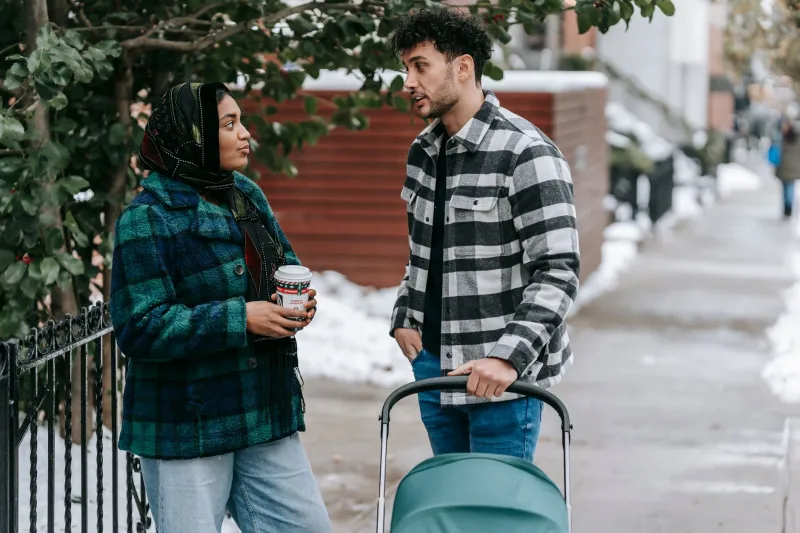
Sometimes Iryna Kovalchuk starts a sentence in English, pivots into Russian somewhere around the verb, and lands the punchline in Belarusian. Her teenage daughter, born in New Jersey, follows every word without blinking. Her American coworkers, naturally, look completely lost.
"It's not like I'm trying to confuse anyone," Iryna says, laughing. "It just comes out. Each language has the right word for the right feeling. You stop choosing after a while."
This is the everyday reality for a significant chunk of the Belarusian diaspora in the US — a community that quietly code-switches its way through workplaces, family dinners, group chats, and church basements. Three languages, sometimes four if you count the hybrid slang that's evolved inside diaspora households. Linguists have a tidy term for it. Belarusian Americans just call it talking.
What Code-Switching Actually Means (And Why It's Not Just Mixing Things Up)
Code-switching gets thrown around a lot, but in the academic sense it refers to the practice of alternating between two or more languages — or dialects, or registers — within a single conversation, sometimes within a single sentence. It's well-documented in bilingual and multilingual communities everywhere, from Spanish-English speakers in Texas to Cantonese-English speakers in San Francisco.
For Belarusians, the situation has an extra layer of complexity that most outsiders don't immediately grasp. Belarus sits at a linguistic crossroads where Russian and Belarusian have coexisted — often uncomfortably — for decades. Inside Belarus itself, a mixed vernacular called Trasianka emerged organically, blending the two languages in ways that linguists still debate. Then those speakers immigrated to the United States, added English to the mix, and the whole thing got even more interesting.
"What you get in diaspora households is something genuinely distinct," says Dr. Alena Marchuk, a sociolinguist who studies post-Soviet immigrant communities. "It's not careless speech. There's real grammatical structure to how people are switching. They're not just grabbing random words — they're making choices, even if unconsciously."
The Grammar of Belonging
Ask Belarusian Americans which language they use for which situations, and patterns emerge fast.
English handles the practical world — work emails, school pickups, anything involving a government form or a customer service hold line. Russian often carries the emotional weight of family history, the language of grandmothers and old photographs and Soviet-era idioms that don't quite translate. Belarusian, for those who speak it, tends to appear in moments that feel almost ceremonial — folk songs, toasts, conversations about home that are really about something much larger than geography.
And then there's the hybrid stuff that doesn't have an official name but that diaspora families recognize immediately. Call it Bel-glish, call it the kitchen language, call it whatever — it's the patchy, alive, completely functional dialect that happens when you've been living between worlds long enough that the seams start to show.
"My mom will say something like, ya poshla na shopping, kupit' dzhynsy i maybe zaiti v café," says Vasil, 28, who grew up in Chicago after his family emigrated from Hrodna in the late 1990s. "That's Russian structure, Belarusian vowel sounds, and three English nouns just dropped straight in. It's completely normal to me. When I tried to explain it to my college roommate, he thought I was making it up."
When Language Becomes a Loyalty Test
Here's where it gets politically loaded, and in Belarusian communities, it gets politically loaded fast.
For many Belarusians of a certain generation, Russian was the language of prestige, of education, of getting ahead. Belarusian was rural, old-fashioned, something you spoke at home if you spoke it at all. The Soviet project was remarkably effective at making people feel that way. So a lot of diaspora members arrived in the US primarily Russian-speaking, with Belarusian somewhere in the background — understood, maybe, but not practiced.
Then 2020 happened. The post-election protests, the crackdowns, the explosion of Belarusian national identity that spread through diaspora communities like a current. Suddenly the language question wasn't just linguistic — it was political, it was personal, it was about which side of history you wanted to be on.
"People started learning Belarusian who had never really spoken it before," says Maryia, a community organizer in Brooklyn who runs cultural events for the local diaspora. "I saw it happen in real time. People in their thirties and forties downloading apps, joining Telegram channels in Belarusian, switching their Instagram captions. It wasn't just language learning. It was a statement."
The code-switching shifted too. Belarusian words started appearing more deliberately in conversations that used to be mostly Russian. Not always fluently, not always accurately, but with intention. The language became a flag you could carry in your mouth.
The Kids Are Doing Something Else Entirely
The second generation — the ones who grew up in American schools, who dream in English, who learned their parents' languages at kitchen tables and holiday dinners — occupy their own fascinating linguistic space.
Many understand Russian and varying amounts of Belarusian but feel most comfortable in English. When they code-switch, they're often going in the opposite direction from their parents: English as the base, with Belarusian or Russian words dropped in for flavor, for humor, for things that just don't have good English equivalents.
There's a whole vocabulary of untranslatables that diaspora kids grow up knowing: sumna (a melancholy that's softer than sadness), hutka (quickly, but with an urgency that "quickly" doesn't quite capture), bul'ba (potatoes, yes, but also the entire emotional weight of Belarusian identity wrapped into one root vegetable).
"I use Belarusian words with my American friends now," says Tanya, 22, whose parents came from Minsk. "They've started using them too. My friend group just says sumna now when something is a little sad but also kind of okay. It crossed over."
Why This Matters Beyond Linguistics
Language is how communities mark their edges — who's inside, who's outside, who gets the joke. For a diaspora that's often invisible to mainstream American culture (see: the exhausting "wait, is that Russia?" conversation that every Belarusian American has had approximately nine hundred times), the private language of code-switching is one of the most intimate forms of community-building available.
You can't fake it. You either grew up with it or you didn't. When two Belarusian Americans meet and start naturally drifting between languages mid-sentence, there's a recognition that happens that no flag pin or cultural festival can replicate. It's a handshake that happens in the throat.
"It tells you where someone is from, when they came, what their family valued, what they've held onto," Dr. Marchuk says. "A linguist can hear an entire immigration history in the way someone switches languages. It's a map."
For Iryna in New Jersey, the map leads back to a kitchen in Brest and forward to a life that doesn't fit neatly into any single language. So she uses all of them. Her daughter does too, in her own way, with her own mixture. And someday, maybe, her daughter's kids will have their own version — a little more English, a little less Soviet-era Russian, hopefully still some Belarusian in there somewhere.
Languages don't just carry information. They carry people. And the Belarusian diaspora, it turns out, is carrying quite a few.